Financing Nature Conservation: Translating Fascinating Research into Practical Insights
SFI is regularly ranked among the top 10 finance institutes worldwide and the top three in Europe. Its faculty conducts fundamental research, has it published in top finance journals, and shares the latest academic insights with broader audiences through a range of knowledge exchange activities. As SFI Prof. Giroux noted, SFI—and the conference specifically—provides an opportunity to meet practitioners and others in order to exchange fresh perspectives and challenge one's assumptions.
Financing Nature Conservation: Insights into Blended Finance Opportunities
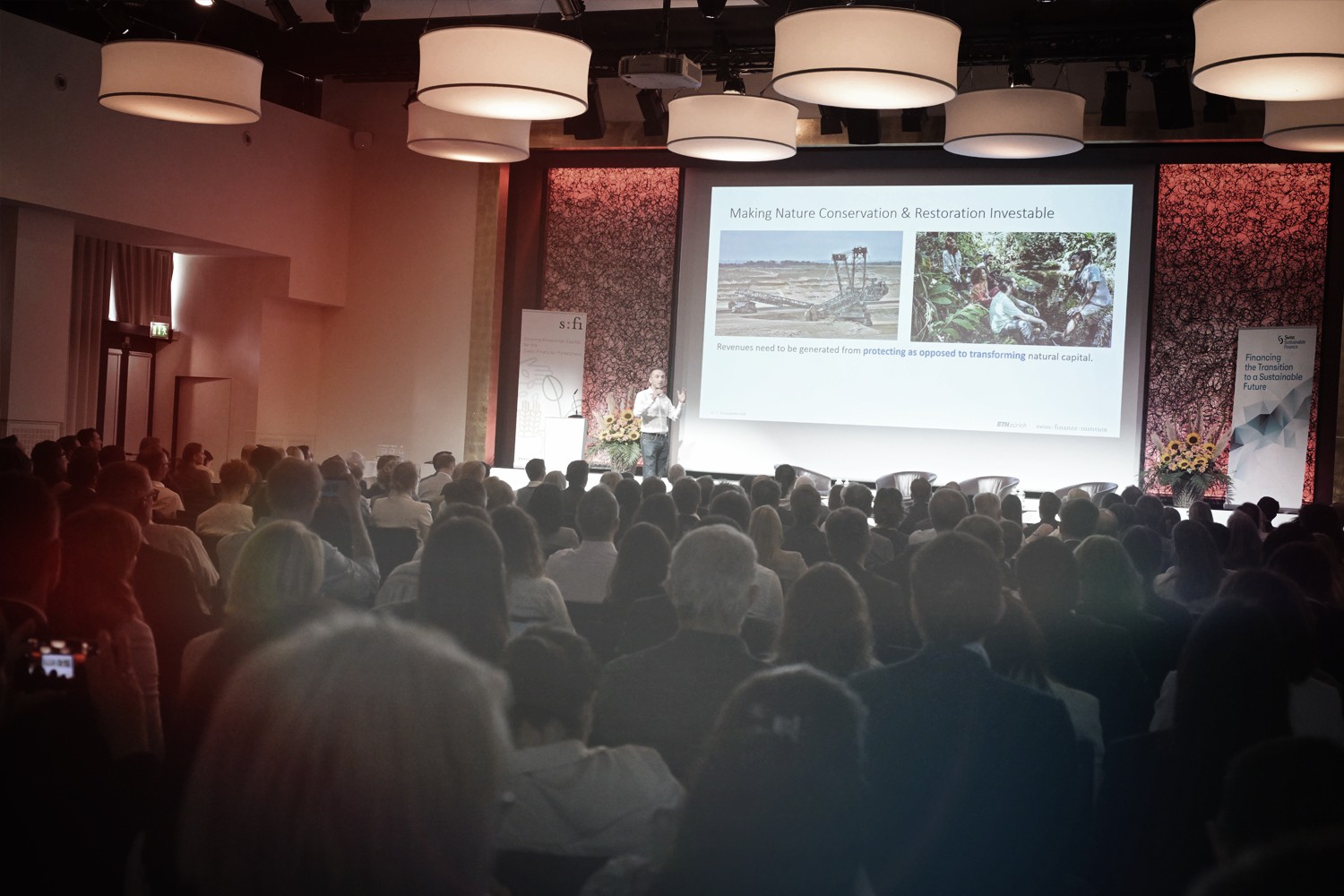
SFI Prof. Giroux began by noting that a huge proportion of investment has a negative impact on biodiversity, outweighing positive impacts by a factor of thirty. He posed the question, as 90 percent of positive-impact investment in 2023 came from public finance, how can private finance be encouraged and equipped to get more involved? His analysis of potential monetization mechanisms and innovative approaches to de-risking nature-based solution projects led him to raise the topic of blended finance. SFI Prof. Giroux asked audience members to raise their hands if they were familiar with the subject. Many hands remained in laps, suggesting a great opportunity to share new insights with the practitioners present.
Blended finance mixes concessional capital (below market rate) from public or philanthropic sources with commercial capital. It is especially relevant in more difficult investment conditions such as investing in lesser-developed countries with opaque data and local currency exposure. Setting out a number of hurdles and opportunities, SFI Prof. Giroux explained how scaling the benefits involves improving transparency, standardization, and discipline. He went on to explain how his research linked the level of concessionality with impact and systemic risks, identifying the need to balance risk protection and commercial discipline. Surprisingly, organizational and informational frictions—such as limited in-house expertise, self-imposed governance constraints, and internal inertia—appear to be more significant barriers to blended finance investments than traditional financial obstacles are. This suggests that the challenge of mobilizing capital for blended finance lies less in financial market failures and more in overcoming institutional barriers and knowledge gaps.
His presentation raised awareness of how research can provide valuable data to help address these and other challenges faced by decision-makers, including helping determine which projects are worth supporting, matching projects to finance instruments, increasing transparency, and building capacity.
SFI Prof. Giroux conducts academic research in sustainable finance to help stakeholders make sound decisions based on robust evidence rather than assumptions. "Exchanging ideas with practitioners is key for empirical research. Without good dialogue, I would not ask the relevant questions, nor work on the right data, nor translate findings into the proper language. I might still have fun, but would do a poor service to society". We could not put it better ourselves, and this vital form of knowledge exchange is just one of the ways in which SFI grows knowledge capital for the Swiss financial center, thus contributing to Switzerland's prosperity.

Further Reading:
- Blended finance, Journal of Financial Economics (183), 2026 (with C. Flammer and G.M. Heal).
- Biodiversity finance, Journal of Financial Economics (164), 2025 (with C. Flammer and G.M. Heal).
- Scaling Sustainable Investing in Emerging and Developing Economies: Frictions and Opportunities, SFI Research Paper Series No 26-10, 2026 (with C. Flammer and G.M. Heal).